How to Convert Newtons to Millinewtons
To convert from newtons to millinewtons, multiply the value by 1000. The conversion is linear, meaning doubling the input doubles the output.
Conversion Formula
- Newtons to Millinewtons:
mN = N × 1,000 - Millinewtons to Newtons:
N = mN ÷ 1,000
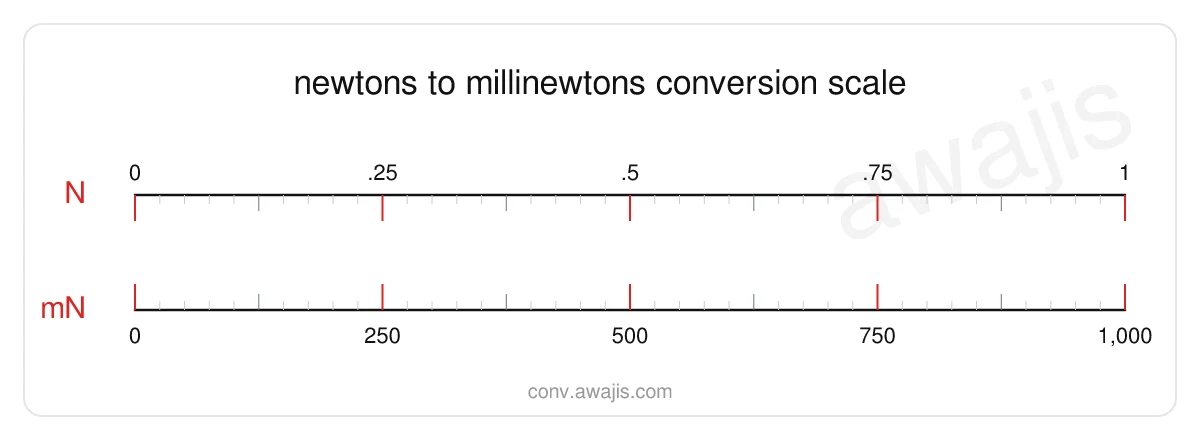
Newtons to Millinewtons Conversion Chart
| Newtons (N) | Millinewtons (mN) |
|---|---|
| 0.1 | 100 |
| 0.25 | 250 |
| 0.5 | 500 |
| 1 | 1000 |
| 2 | 2000 |
| 3 | 3000 |
| 5 | 5000 |
| 10 | 10000 |
| 20 | 20000 |
| 25 | 25000 |
| 50 | 50000 |
| 100 | 100000 |
| 250 | 250000 |
| 1000 | 1000000 |
Understanding the Units
What is a Newton?
The newton is the SI derived unit of force, equal to the force needed to accelerate one kilogram by one meter per second squared (1 N = 1 kg·m/s²).
Named after Sir Isaac Newton (1643–1727), whose three laws of motion underpin classical mechanics.
Common contexts: mechanics, engineering.
What is a Millinewton?
A millinewton equals one thousandth of a newton.
Common contexts: precision instruments, biomechanics.
Real-World Reference Points
| Item | Newtons (N) | Millinewtons (mN) |
|---|---|---|
| Weight of an apple (≈100 g) | 1 | 1000 |
| Weight of 1 kg on Earth | 9.81 | 9810 |
How to Convert Newtons to Millinewtons
To convert newtons to millinewtons, multiply by 1,000. This is a straightforward SI prefix conversion.
Conversion Formula
- Newtons to Millinewtons: mN = N × 1,000
- Millinewtons to Newtons: N = mN ÷ 1,000
Common Conversions
| Newtons | Millinewtons |
|---|---|
| 0.001 | 1 |
| 0.01 | 10 |
| 0.05 | 50 |
| 0.1 | 100 |
| 0.25 | 250 |
| 0.5 | 500 |
| 1 | 1,000 |
| 2 | 2,000 |
| 4.9 | 4,900 |
| 5 | 5,000 |
| 9.81 | 9,810 |
| 10 | 10,000 |
| 25 | 25,000 |
| 50 | 50,000 |
Understanding the Units
What Is a Newton?
The newton (N) is the SI derived unit of force. It is defined by Newton's second law: one newton is the force required to accelerate a mass of one kilogram at one meter per second squared (F = ma, so 1 N = 1 kg·m/s²). Named after Sir Isaac Newton, the unit is used universally in physics and engineering for measuring forces ranging from subatomic interactions to spacecraft thrust.
What Is a Millinewton?
The millinewton (mN) equals 0.001 newtons. It is the standard unit for measuring very small forces — those too small to express conveniently in newtons but too large for micronewtons. Applications include MEMS sensor calibration, biomedical force testing, insect biomechanics research, and precision spring design.
Real-World Millinewton Forces
| Example | Approximate force |
|---|---|
| Grain of rice on a surface | ~1 mN |
| Touchscreen tap | ~5 mN |
| Butterfly wing downstroke | ~200 mN |
| Pencil pressing on paper | ~300 mN |
| Ant carrying food | ~1,000 mN (1 N) |
SI Prefixes for Force
The newton can be combined with any SI prefix. Here are the most common ones used for force measurements:
| Prefix | Symbol | Factor | Unit |
|---|---|---|---|
| nano | n | 10⁻⁹ | nanonewton (nN) |
| micro | µ | 10⁻⁶ | micronewton (µN) |
| milli | m | 10⁻³ | millinewton (mN) |
| — | — | 10⁰ | newton (N) |
| kilo | k | 10³ | kilonewton (kN) |
| mega | M | 10⁶ | meganewton (MN) |
Related converters: millinewtons to newtons, kilogram-force to newtons, newtons to pound-force, newtons to dynes, and micronewtons to millinewtons.