How to Convert Newtons to Poundals
To convert from newtons to poundals, multiply the value by 7.23301. The conversion is linear, meaning doubling the input doubles the output.
Conversion Formula
- Newtons to Poundals:
pdl = N × 7.23301 - Poundals to Newtons:
N = pdl ÷ 7.23301
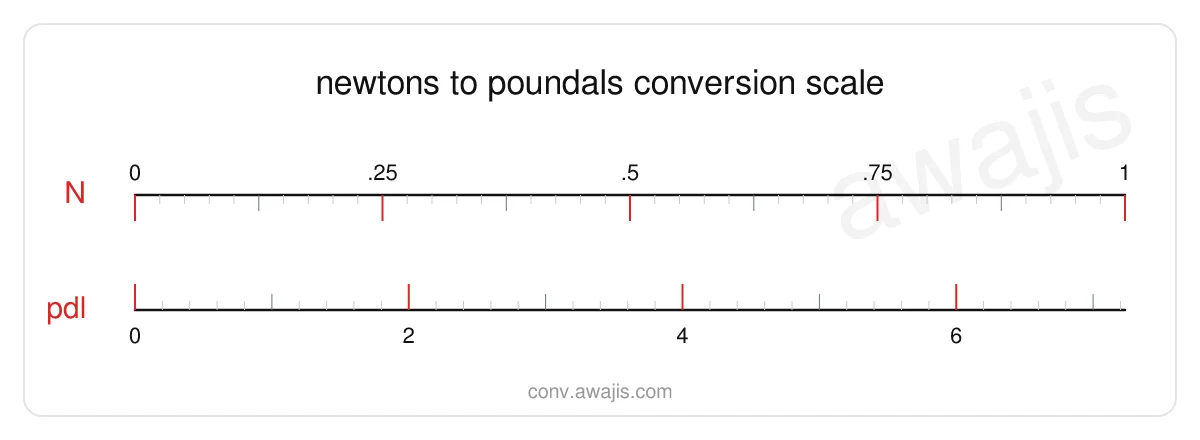
Newtons to Poundals Conversion Chart
| Newtons (N) | Poundals (pdl) |
|---|---|
| 0.1 | 0.723301 |
| 0.25 | 1.808253 |
| 0.5 | 3.616505 |
| 1 | 7.23301 |
| 2 | 14.46602 |
| 3 | 21.69903 |
| 5 | 36.16505 |
| 10 | 72.3301 |
| 20 | 144.6602 |
| 25 | 180.82525 |
| 50 | 361.6505 |
| 100 | 723.301 |
| 250 | 1808.2525 |
| 1000 | 7233.01 |
Understanding the Units
What is a Newton?
The newton is the SI derived unit of force, equal to the force needed to accelerate one kilogram by one meter per second squared (1 N = 1 kg·m/s²).
Named after Sir Isaac Newton (1643–1727), whose three laws of motion underpin classical mechanics.
Common contexts: mechanics, engineering.
What is a Poundal?
A poundal equals approximately 0.138255 newtons — the force needed to accelerate one pound-mass by one foot per second squared.
Common contexts: absolute foot-pound-second system.
Real-World Reference Points
| Item | Newtons (N) | Poundals (pdl) |
|---|---|---|
| Weight of an apple (≈100 g) | 1 | 7.233 |
| Weight of 1 kg on Earth | 9.81 | 70.9558 |
How to Convert Newtons to Poundals
To convert newtons to poundals, multiply by 7.23301385. The factor is the SI-to-FPS reciprocal of the poundal\'s definition: one poundal is the force that accelerates 1 pound-mass at 1 ft/s². Converting through SI base units gives 0.45359237 kg × 0.3048 m/s² = 0.138254954376 N exactly, and the reciprocal of that yields 7.23301385 poundals per newton.
Conversion Formula
- Newtons to Poundals: pdl = N × 7.2330138512
- Poundals to Newtons: N = pdl × 0.138254954376
- Through pound-force: 1 lbf = 32.17404856 pdl (the dimensionless g in FPS)
The conversion is exact, not measured: all three contributing constants — the 1959 international pound, the international foot, and the metric definitions of kilogram and metre — are defined exactly. The poundal-to-newton bridge therefore inherits an exact decimal value.
Common Conversions
| Newtons (N) | Poundals (pdl) | Pound-force (lbf) |
|---|---|---|
| 0.5 | 3.6165 | 0.1124 |
| 1 | 7.2330 | 0.2248 |
| 2 | 14.4660 | 0.4496 |
| 4.4482 (1 lbf) | 32.1740 | 1.0000 |
| 5 | 36.1651 | 1.1240 |
| 9.80665 (1 kgf) | 70.9316 | 2.2046 |
| 10 | 72.3301 | 2.2481 |
| 20 | 144.6603 | 4.4962 |
| 50 | 361.6507 | 11.2404 |
| 100 | 723.3014 | 22.4809 |
| 250 | 1,808.2535 | 56.2022 |
| 500 | 3,616.5069 | 112.4045 |
| 1,000 | 7,233.0139 | 224.8089 |
| 5,000 | 36,165.0693 | 1,124.0447 |
Understanding the Units
What Is a Newton?
The newton (N) is the SI derived unit of force, defined as 1 kg·m/s². It is a "coherent" unit, meaning Newton\'s second law F = m × a holds without inserting a numerical conversion factor when all quantities are in SI base units. Adopted in 1948, the newton is the universal language of modern mechanics, engineering, and physics.
What Is a Poundal?
The poundal (pdl) is an absolute Imperial unit of force, defined as the force needed to accelerate one pound-mass (lbm) at one foot per second squared: 1 pdl = 1 lbm·ft/s² = 0.138254954376 N exactly. The poundal exists for one purpose: to make the FPS system coherent so that F = m × a works directly with pound-mass, foot, and second, with no numerical fudge factor.
Absolute vs Gravitational Force Units
This is the key conceptual point. The pound-force is gravitational: it is defined as the weight of one pound-mass at Earth\'s surface, and it carries the value of g implicitly. The poundal is absolute: it has no gravity baked in, only mass and acceleration. In any FPS calculation where you do not want g cluttering the algebra — projectile motion in vacuum, momentum, impulse, kinetic energy in pure kinematics — the poundal is the cleaner choice.
Real-World Poundal References
Because the poundal is small (1 pdl ≈ 0.14 N) and gravity-free, it suits physics-class problems more than everyday weighing. Practical anchors:
| Source of Force | Newtons (N) | Poundals (pdl) |
|---|---|---|
| Standard apple weight (≈100 g) | 0.98 | 7.09 |
| Weight of one pound-mass (1 lbm × g) | 4.448 | 32.17 |
| Force to lift a 1-kg textbook | 9.81 | 70.96 |
| Hand-thrown baseball, peak push during throw | 20–40 | 145–290 |
| Person pushing a stalled shopping trolley | 50–150 | 362–1,085 |
| Average adult bite force | ~700 | ~5,063 |
| 9 mm pistol bullet at muzzle (peak) | ~3,000 | ~21,700 |
| Rifle bullet on chamber pressure peak | ~15,000 | ~108,500 |
| Small model-rocket motor (Estes C6) | peak ~14 | ~101 |
| Compact-car braking force (full stop) | ~7,000 | ~50,600 |
Notice how the poundal scale produces large numbers for everyday forces. That is the chief practical reason it lost ground to the newton and pound-force: humans dislike four-digit force values for ordinary objects.
Poundals in Physics Education and Ballistics
British physics syllabuses through the mid-20th century treated the poundal as the standard FPS force unit precisely because it keeps F = m × a clean when masses are in pounds. Sample exam-style problem: "A 16-pound mass falls freely; what is the gravitational force on it in poundals?" Answer: F = m × g = 16 lbm × 32.174 ft/s² = 514.8 pdl. No conversion constants, no slugs, no headaches — that was the pedagogical appeal.
In external ballistics, the poundal occasionally survives in older Imperial-only references for muzzle thrust, drag force, and trajectory calculations. A bullet experiencing 3,000 pounds-force of pressure-on-base inside the barrel registers as 96,522 pdl in poundal arithmetic — large numbers, but consistent with mass-in-grains and velocity-in-feet-per-second. Modern internal-ballistics codes work in SI, but the conversion remains useful when digesting period literature.
Related Force Converters
- Poundals to Newtons — the reverse direction
- Newtons to Pounds-force — gravitational Imperial unit
- Pounds-force to Newtons — 32.174 poundals per lbf
- Newtons to Dynes — the CGS absolute force unit
- Newtons to Kilonewtons — SI step up
Brief History of the Poundal
The poundal was introduced in 1879 by Irish-Scottish engineer and physicist James Thomson — older brother of Lord Kelvin — to solve a specific irritation in Victorian engineering. Practitioners wanted to use Newton\'s second law in Imperial units without dragging the gravitational constant g through every equation. The slug, the other FPS solution, redefined mass; Thomson\'s poundal kept mass in familiar pounds and instead defined a small new force unit. The proposal was formalised at the British Association meeting in Dublin that year.
For a few decades the poundal flourished in British physics and engineering texts. But its small magnitude — about one-seventh of a newton — produced unwieldy numbers for ordinary forces, and the parallel rise of SI made it redundant in most professional contexts. By the 1960s the unit was already curatorial; today it survives mainly in physics-education exam questions and historical ballistics references where keeping mass and force units clean still appeals to teachers and antiquarians alike.