How to Convert Kilovolts to Volts
To convert from kilovolts to volts, multiply the value by 1000. The conversion is linear, meaning doubling the input doubles the output.
Conversion Formula
- Kilovolts to Volts:
V = kV × 1000 - Volts to Kilovolts:
kV = V ÷ 1000
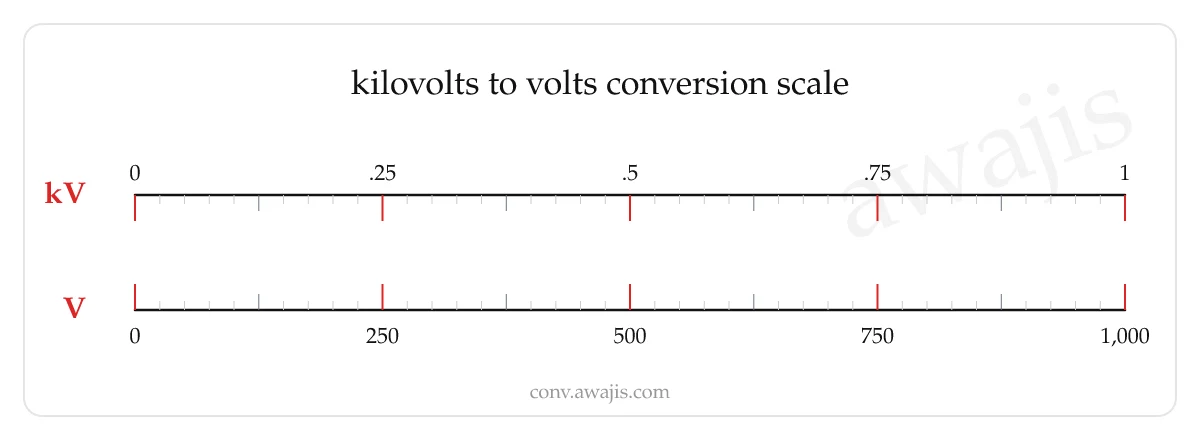
Kilovolts to Volts Conversion Chart
| Kilovolts (kV) | Volts (V) |
|---|---|
| 0.1 | 100 |
| 0.25 | 250 |
| 0.5 | 500 |
| 1 | 1000 |
| 2 | 2000 |
| 3 | 3000 |
| 5 | 5000 |
| 10 | 10000 |
| 20 | 20000 |
| 25 | 25000 |
| 50 | 50000 |
| 100 | 100000 |
| 250 | 250000 |
| 1000 | 1000000 |
Understanding the Units
What is a Volt?
The volt is the SI derived unit of electric potential difference, equal to one joule per coulomb (1 V = 1 J/C = 1 W/A).
Named after Alessandro Volta (1745–1827), Italian physicist who invented the first electrical battery.
Common contexts: power systems, electronics, batteries.
Real-World Reference Points
| Item | Kilovolts (kV) | Volts (V) |
|---|---|---|
| AA battery | 0.0015 | 1.5 |
| USB power | 0.005 | 5 |
| US wall outlet | 0.12 | 120 |
Common Conversions
Kilovolts converted to volts, using voltage levels found across real power systems.
| Kilovolts | Volts |
|---|---|
| 0.4 | 400 |
| 1 | 1,000 |
| 3.3 | 3,300 |
| 6.6 | 6,600 |
| 11 | 11,000 |
| 12 | 12,000 |
| 22 | 22,000 |
| 33 | 33,000 |
| 66 | 66,000 |
| 69 | 69,000 |
| 132 | 132,000 |
| 220 | 220,000 |
| 400 | 400,000 |
| 765 | 765,000 |
Voltage Levels Across the Power Grid
Kilovolts describe the higher stages of the electricity network. Power is generated, stepped up to high voltage for transmission, then stepped back down through distribution to the low voltages that reach homes. Everyday devices run on a few volts, while the grid that feeds them runs on tens or hundreds of kilovolts.
| Stage | Typical voltage (kV) | Volts |
|---|---|---|
| US household outlet | 0.12 kV | 120 V |
| Low-voltage three-phase supply | 0.4 kV | 400 V |
| Primary distribution feeder | 11 kV | 11,000 V |
| Sub-transmission | 33–66 kV | 33,000–66,000 V |
| High-voltage transmission | 132–275 kV | 132,000–275,000 V |
| Extra-high-voltage transmission | 400–765 kV | 400,000–765,000 V |
Related electrical tools: volts to kilovolts, millivolts to volts, megavolts to volts, and volts to microvolts.